
The First 30 Days With Your New Helper in Singapore
Almost every first-month problem we get called about turns out to be a communication problem wearing the costume of a performance problem. Two people can both say the kitchen is clean and mean different rooms. Here is what the first 30 days actually looks like, from the agency that takes the call when it goes wrong.
Day one
Day one is not a work day, and often cannot be. A first-time helper must attend the Settling-in Programme within 7 days of arriving, excluding Sunday and public holidays. She may not attend on her arrival day, and may only start work once she has been.
Show her where she sleeps before anything else. You must provide at minimum a mattress, pillow, blanket, bathroom amenities and toiletries, and she must not sleep in the same room as an adult or teenage male. Tell her where any cameras are, and there must be none where she sleeps or bathes.
Her phone is hers, so give her the wifi password before she asks. Write your number and the home address on a card for her pocket. Hand over keys once you have shown her the door and the lock. Give her a float for marketing and a notebook, and do not chase change to the cent.
Eat together if you can, and ask what she eats and whether she fasts. Do not ask her to cook for the family on her first evening to see what she can do. A good first day is quiet and over early: she goes to bed knowing where the toilet is and what time breakfast is.
What goes wrong is almost never competence
"Clean the kitchen" means, to you, the hob, the sink, the counter, the floor and the bin. To her it may mean the dishes done and the counter cleared, because that is what it meant in the last house she worked in. Neither of you is wrong. Nobody said which one.
That is nearly every early complaint we hear. She was given an instruction that carried a complete picture in your head and none in hers. Correct the same thing four times in a month and you have not taught her a routine, you have taught her that you are unhappy and she does not know why.
Week one: write the routine down together
Sit down for forty minutes with paper and go room by room. Agree what finished looks like for each job, what happens daily and weekly, and which day the weekly things happen. Let her write her own copy in her own language, and put it on the fridge. If your home keeps halal, or she fasts, the kitchen rules and the Ramadan timing belong on that same sheet in week one, and our page for Muslim and Malay households covers Ramadan and the halal kitchen in detail.
Two things decide whether it holds. Put times against it, so 7am is breakfast and laundry follows the school run. And keep it short: forty daily tasks is a list she will fail, ten she can finish is worth more, whether the role is childcare or mostly housekeeping.
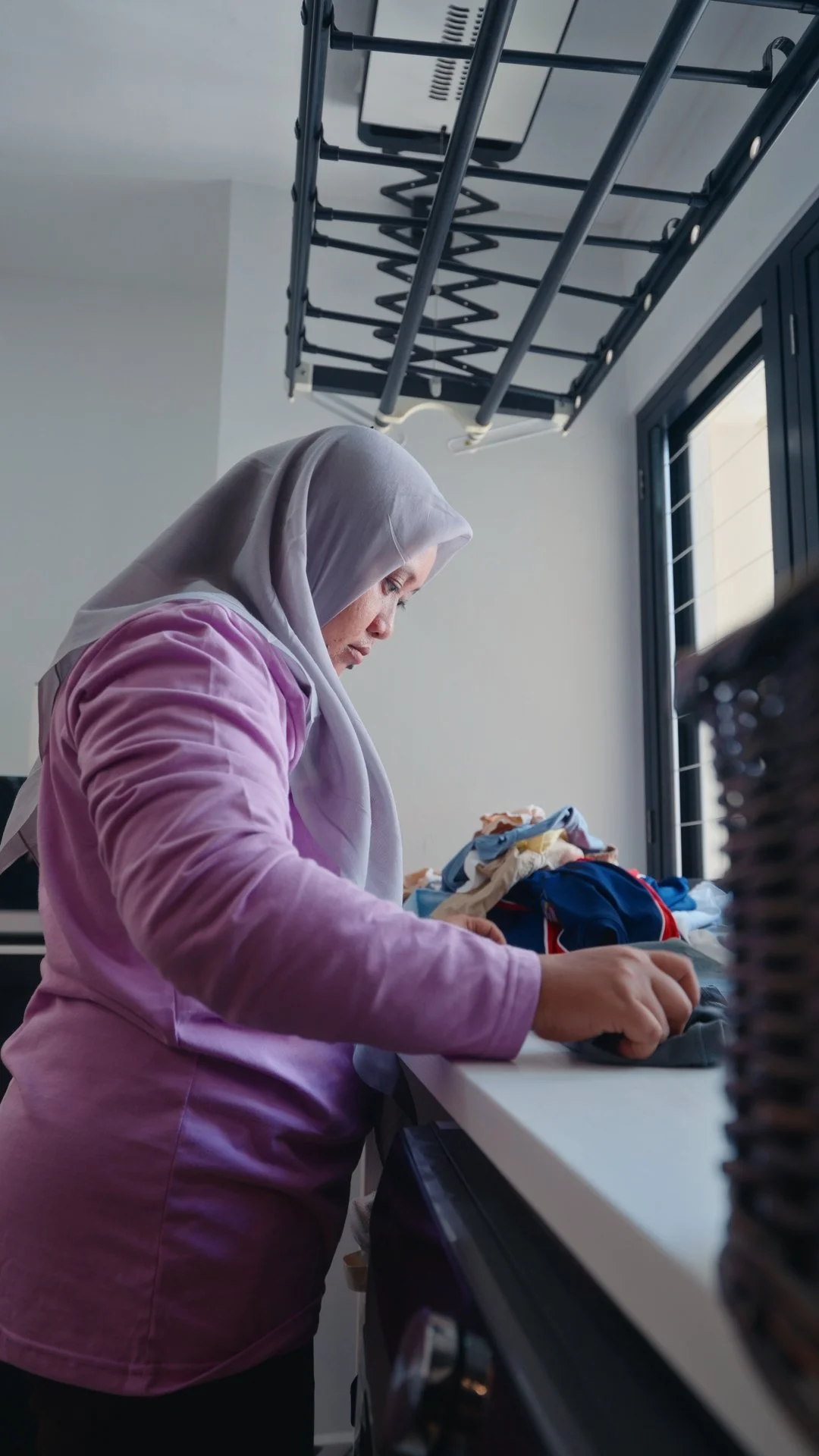
Teach each task in four steps rather than one demonstration. Show her, do it together, watch her do it, leave her to it. MOM notes that a helper from a rural area may not have used modern appliances or lived in a high-rise before.
Rest days start now, not once she settles in
She is entitled to one rest day a week from the beginning. You agree which day between you, and at least one rest day a month cannot be compensated away.
The flexibility is real: one full day or two half days, she may spend it at home, and a rest day she cannot take can be deferred by a month. If she agrees to work one, you must pay at least a day's salary on top of her basic salary. Start in week one, because the employer who defers rest days until she has settled in is the one still deferring them in month four.
Food, home, and a person having a hard week
Somewhere around day five it lands. She has left her own children with her mother or her sister to help look after yours, and the language, the food and the rubbish chute are all slightly wrong. MOM says plainly that she may feel homesick and lonely, and asks you to help her contact her family.
The practical version of warmth is wifi that reaches her room, a call home in the first few days, and food she can actually eat. You must provide three meals a day, and if she cannot eat what your family eats, that is a problem to solve rather than a preference to override. One bag of rice she recognises has repaired more placements than any talk about performance.
Money: in full, on time, and written down
Singapore does not set a minimum wage for migrant domestic workers. MOM requires only that you pay the salary you declared in the Work Permit application, in full and on time.
In practice that means every month, no later than 7 days after the last day of the salary period, which cannot run longer than a month. Pay into her own bank account where you can. MOM says it should not be a joint account with you, and if she asks for bank transfer you have to do it. If you pay cash, keep a record and both sign it every month.
Since 1 January 2019 you must not keep your helper's salary or any money belonging to her, even if she asks you to hold it, and you must not keep her bank book or bank card. Employers do this to be kind. Help her open her own account instead.
Weeks two to four: what to fix, what to call us about
Most of month one is yours to fix. She is slow, she forgot, she did it the way the last house did it. That is week three, not a failed placement. Expect three months before the house runs without you thinking about it.
Call your agency, early, when:
- She is not eating, not sleeping, or upset and will not say why.
- Something about the job was misunderstood before she arrived: night duty, a second household, eldercare nobody mentioned.
- There is a health issue, an injury or a question about pregnancy.
- Money, her phone, her passport or her day off has become a standing argument.
- You are thinking about ending the placement. Do not work through that one alone.
A conversation in week two is usually a phone call. The same problem in month three is usually a transfer. Our support after placement does not end once she has started, and we would rather take the early call.
The 30-day review
At the end of the month, sit down at the table for twenty minutes. Three questions, answered both ways. What is going well. What is confusing or too much. What would you change about the routine.
Then take out the sheet from week one and edit it in front of her. That tells her the routine is a working agreement rather than a test. It is where most placements either settle or quietly begin to fail. Ask her directly whether she has enough food, whether she is sleeping, and whether she has called home. She may not volunteer it.
Keep the sheet and repeat the twenty minutes every few months. The households that do are the ones for whom Work Permit renewal, two years on, is an easy decision.
Questions employers ask in the first month
- When can my new helper start work?
- If she is a first-time helper in Singapore, only after she has attended the Settling-in Programme. You must send her within 7 days of her arrival, excluding Sunday and public holidays, and she is not allowed to attend on her arrival day itself.
- Should she get a rest day in her first month?
- Yes. The entitlement is one rest day a week from the start, and at least one rest day a month cannot be compensated away. If she agrees to work a rest day, you must pay her at least one day's salary on top of her basic salary.
- She keeps doing things differently from how I asked. Is she unsuitable?
- Usually not in month one. Most early problems are unstated expectations rather than ability. Write the routine down with her, room by room, with times against it, then correct against the written version instead of correcting from memory.
- Can I hold her salary or her bank card to keep it safe for her?
- No. Since 1 January 2019 an employer must not keep a helper's salary or any money belonging to her, even if she asks you to, and must not keep her bank book or bank card. Help her open her own account instead.
- When should I call the agency instead of handling it myself?
- Call early if she is not eating or sleeping, if something about the job was misunderstood before she arrived, if there is a health issue, or if money, her phone or her day off has become a standing argument. The same problem in month three is usually a transfer.