
How to Read a Helper's Biodata, and What It Will Not Tell You
A biodata is really two documents stapled together. A small part is verified: passport, age, education certificate, her Singapore employment record. The larger part, including the skills grid every employer reads first, is self-reported. We prepare these documents for a living, so here is the honest version of how to read one.
What a biodata actually is
The standard profile document for a domestic helper, in roughly the same shape at every agency here. Where an agency matched her to you, its MOM licence conditions require it to give you her full biodata, in the prescribed form, before anyone applies for a Work Permit.
Six blocks, each good for something different.
- Personal details. Name, date of birth, nationality, passport, religion, marital status. The verified spine.
- Family situation. Her children, their ages, and who is minding them. The best predictor on the page of whether she finishes two years.
- Education. MOM requires at least eight years of formal education with a recognised certificate.
- Work history. Countries, employers, dates, household size, duties. The Singapore portion is checkable. The overseas portion is not.
- Skills grid. Cooking, infant care, elderly care, cleaning, pets. Read first by everyone, and deserving of the most scepticism.
- Language and preferences. English, Mandarin, Malay, dialect. Rest days, pork, dogs, a windowless room.
If the listing you saw online looked thinner, the rule is working. Public advertising is limited to her name, nationality, skills, food preferences, job durations and languages. No photograph, no age.
Most of a biodata is self-reported
Here is the sentence the rest of this article hangs on. A skills grid with ticks against cooking, elderly care and infant care is the candidate's own assessment of herself. It is usually filled in through an agent in her home country, in a language she is translating out of, and sometimes optimistically. Nobody tested it.
That is not dishonesty, and assuming it is will make you a worse interviewer. A tick box has no scale. A woman who has cooked rice and fried fish for her own family every day for ten years is telling the truth when she ticks cooking, even though you meant a repertoire for five. She also knows the tick is what gets her shortlisted.
A tick is a claim, not a fact. The interview exists to turn every tick you care about into a specific story with dates and a routine attached.
What is checkable, and what is only a claim
Sort the document into two columns before anything else. The left you can confirm. The right you can only probe.
| Checkable | A claim you must test |
|---|---|
| Name, date of birth, nationality, passport | "Good with children" |
| Age against MOM's limits | "Can cook Chinese food" |
| Education certificate | Her rating of her own English |
| Singapore work permit history and dates | Why a previous placement ended |
| Whether she has worked here before | Overseas employers and duties |
Age has a hard rule behind it. A helper must be from 23 to below 50 years old at the Work Permit application, and one aged 50 and above may only renew her Work Permit until she turns 60. That is MOM's eligibility requirement, not agency preference.
Her Singapore employment record is the strongest thing on the page, and you can pull it yourself. MOM lets an employer check a prospective helper's employment record through its FDW eService with Singpass, using her name or FIN, nationality and date of birth. Your agency can run it too, and its licence conditions require it to hand you that history during selection as a printout it may not alter. If the two disagree, believe the printout.
How to interrogate a skills claim
One rule: ask about a specific past event, never a general ability. "Can you cook?" has one available answer and tells you nothing. A real memory comes back with texture. A rehearsed one does not.
- Not "can you cook". Ask what did you cook most often for your last family, and how did you learn it. Then ask what they did not like.
- Not "are you good with children". Ask tell me about the youngest child you looked after, and walk me through a morning from waking her to leaving the house.
- Not "can you look after my mother". Ask what medicines did she take, and how did you keep track. Then: what did you do the first time she fell.
- Not a self-rating for English. Ask her to describe her last employer's kitchen for half a minute. You are hiring the English you can hear, not the number on the form.
- For any tick that matters, finish with who taught you, and when. A skill has a provenance. A claim does not.
Two mechanics make this work. Talk to her directly, not to whoever is holding the phone. And ask the questions that matter twice, in different words, twenty minutes apart. Experience survives that. A prepared answer usually does not. For a baby, our page on choosing a childcare helper sets out which ticks deserve this much attention.
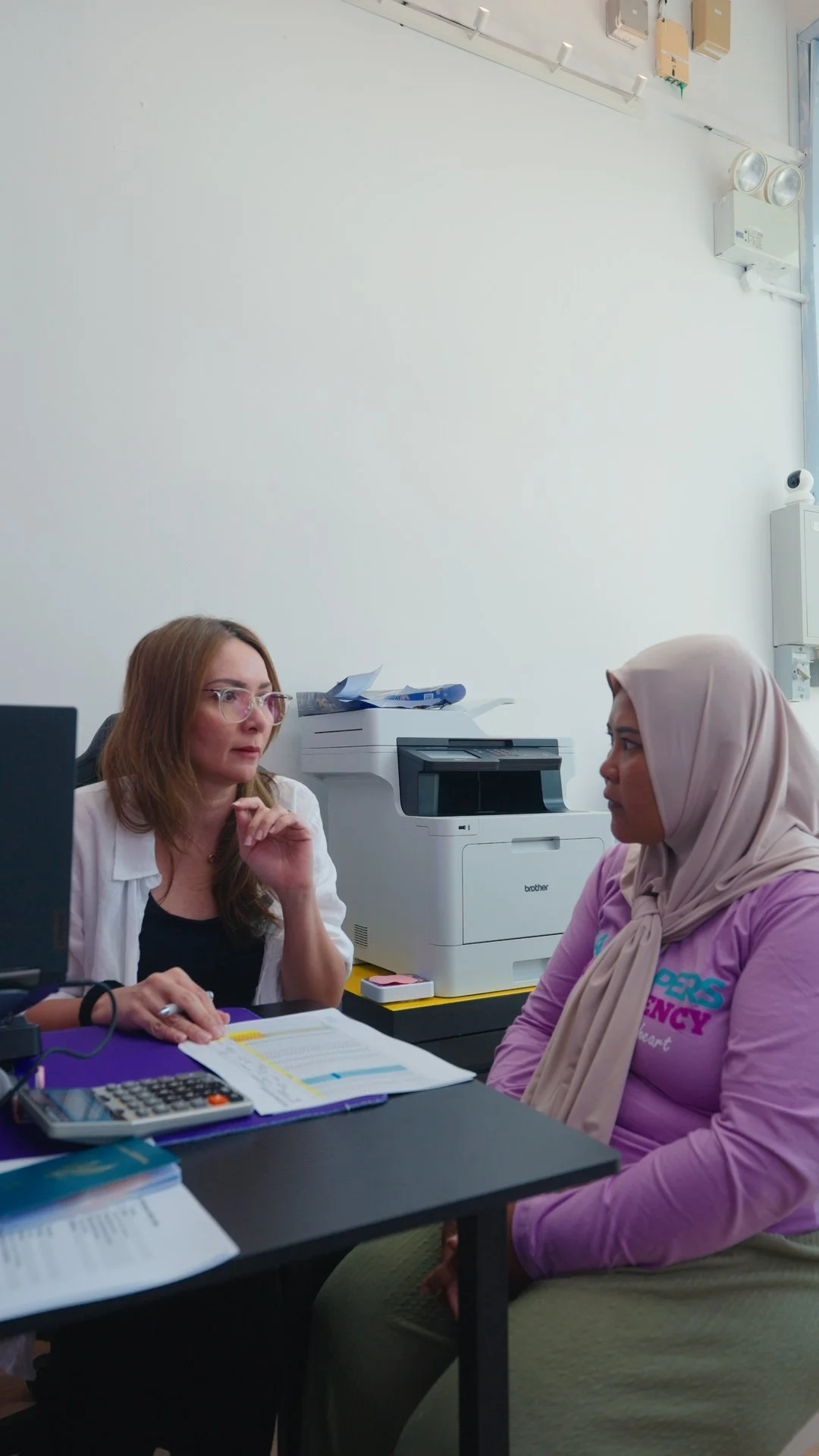
Gaps and short placements are not automatically red flags
Employers see a six month placement or an eighteen month gap and assume the worst. Usually it is unremarkable. A contract ended on schedule. The employer emigrated. The children outgrew the need. A parent fell ill and she went home, which is one of the commonest reasons of all.
So do not screen on the gap. Screen on the answer. A straight answer is specific and slightly boring: a month, a place, a reason, and it comes out the same way when you ask again next week. An evasive one is vague about dates, blames every employer she has had, or shifts between tellings. A pattern of very short jobs, each one somebody else's fault, is worth slowing down for. One, with a clear story, is not.
This matters most when she is already here. The record gives you dates but never reasons, so with a transfer helper ask her, ask the agency, and if you can, ask for a word with her current employer. MOM allows a direct transfer, and that outgoing employer is often the most useful reference you will get.
What we check, and what no agency can check
MOM sets a minimum standard of verification checks for every licensed agency and we work to it. We examine her originals, passport, education certificate and family listing, for discrepancies and alterations. We interview her face to face in her own language about family, education and work experience. We assess whether her appearance and speech match her declared age, and we are told not to lean on the overseas supplier's information or interpreter while we do it.
Now read that list again and notice what is not on it. Every item is about identity, documents and age. None of it is about whether she can cook, or whether she is good with a baby. There is no regulated standard for verifying a skill, because there is no practical way to certify one. That is the honest reason the grid stays a claim.
So we do not rewrite a skills grid to fit the job you have just described. When we know why a placement ended we tell you, and we say whether we have both sides of it or one. If a candidate is wrong for your household we say so, even when she is the one we have available. Three profiles with honest caveats beat ten that look perfect. We place from Indonesia and Myanmar, and have written just as plainly about how little nationality really predicts. After the paperwork, most of what decides a placement happens in the first thirty days, not on the form.
Questions employers ask us
- Is a helper's biodata verified?
- Partly, and the split is the whole point. Identity is checked: passport, age, education certificate, and her Singapore employment record, which your agency must give you as an unaltered printout from MOM's Work Permit Online system. The skills grid is not checked by anyone. It is her own assessment of herself, and you should read it as a claim you still have to test.
- Can I check a helper's employment history myself?
- Yes. MOM lets you check a prospective helper's employment record through its FDW eService using your Singpass. You need her name or FIN, her nationality and her date of birth. Your agency can run it for you, and its licence conditions require it to give you that history during selection, as a printout it may not add to or alter.
- What will a biodata never tell me?
- Temperament, patience, initiative, and how she copes in a household under pressure. None of it is on the form and no agency can certify it. A biodata narrows hundreds of candidates to a handful. The interview and a reference call are where you learn the rest.
- Are employment gaps on a biodata a red flag?
- Usually not. Contracts end on schedule, employers relocate, children grow up and no longer need care, and a parent falling ill back home is one of the commonest reasons a helper goes back. Screen the answer, not the gap. What matters is whether it is specific and stays the same each time you ask.
- How do I test a skill she has ticked on the form?
- Ask about a specific past event instead of a general ability. Not "can you cook" but "what did you cook most often for your last family, and who taught you". Real experience comes back with texture: a dish, a time of day, a child's routine. A rehearsed answer stays general however you push on it.